
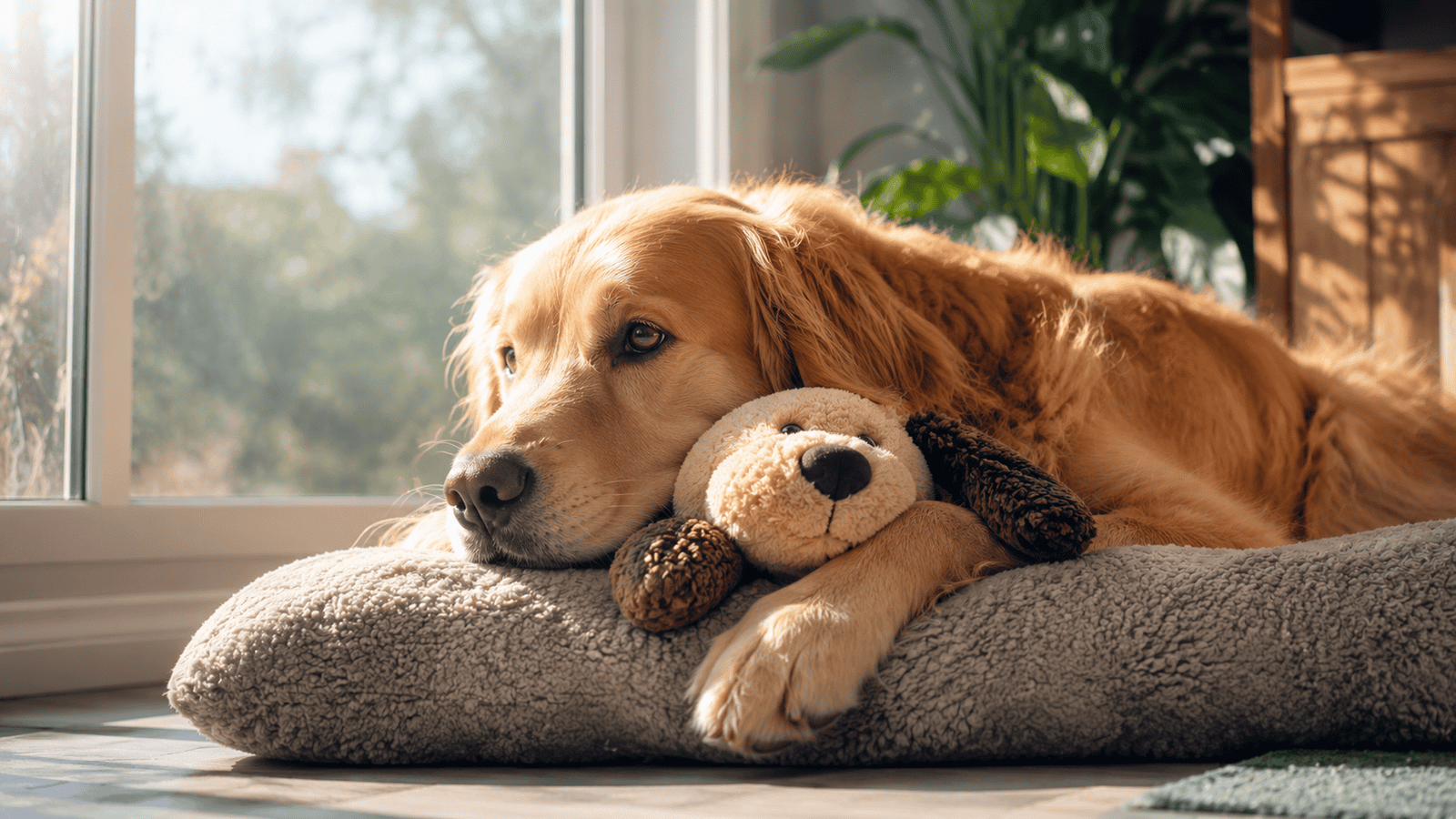
A toy cannot diagnose or treat separation anxiety. At best, the right food-filled toy can give a dog with mild distress or ordinary alone-time boredom a rewarding activity while you leave. A dog who is panicking may ignore food completely—and that is a reason to reassess the plan, not buy a harder puzzle.
This guide compares three food toys with accessible third-party coverage and current manufacturer specifications. They may fit different supervised departure-practice or settling routines, but the sources reviewed do not establish any of them as safe for unattended use. None is presented as a cure.
Pause Before You Buy
First decide whether you are seeing ordinary boredom or separation-related distress. Chewed furniture alone does not establish separation anxiety. The ASPCA lists patterns such as persistent barking or howling, pacing, house soiling, escape attempts, and destruction focused around exits. The University of Illinois College of Veterinary Medicine also stresses that medical problems, teething, noise fears, barrier frustration, and lack of stimulation can look similar.
That distinction matters because a puzzle may help with ordinary boredom while doing little for panic. ASPCA guidance suggests a food-stuffed puzzle as part of counterconditioning for a mild case, but also notes that highly anxious dogs often will not eat while alone. Moderate or severe cases call for a structured behavior plan, and sometimes veterinary treatment—not a succession of new toys.
- A toy may be worth trying when: your dog can eat, explore, and settle after you leave; the problem appears mild; and the product has already been used safely under supervision.
- Call your veterinarian before shopping when: the behavior is new, intense, or accompanied by house soiling, vomiting, loss of appetite, pain, or other health changes.
- Seek behavior help promptly when: your dog tries to escape, injures themself, drools or pants heavily, vocalizes continuously, or cannot remain below the panic threshold during even brief absences.
Affiliate disclosure: GiveItAPaws may earn a commission if you buy through qualifying links, at no extra cost to you. Recommendations are not based on commission. Amazon links are provided for availability; official manufacturer pages remain listed in Sources reviewed for product details and safety instructions.
How we researched this guide
GiveItAPaws did not conduct hands-on product testing. We reviewed veterinary and animal-welfare guidance on separation-related distress, third-party food-toy coverage by a credentialed dog trainer, one clearly labeled first-person product account, and current manufacturer pages for sizing, materials, intended use, and safety instructions. We did not find independent comparative performance tests or clinical trials of these specific products.
Quick comparison
| Product | Best for | Difficulty | Use-status evidence | Main tradeoff |
|---|---|---|---|---|
| KONG Classic | A first food-stuffable toy for average chewers | Adjustable through filling and freezing | Unattended safety not established | Narrow opening can be harder to fill and clean |
| West Paw Toppl | Dogs who need easier access to soft food | Usually easier to start than a narrow cavity | Unattended safety not established | Made for moderate—not extreme—chewers |
| LickiMat Tuff Soother | Simple licking during supervised settling practice | Low problem-solving demand | Supervised use only | Manufacturer says it is not a chew toy |
1. KONG Classic — best starting point for average chewers
The KONG Classic is the most directly supported option in this guide. ASPCA separation-anxiety guidance specifically uses a food-stuffed KONG as an example for building a positive association with mild alone-time distress. Whole Dog Journal, in a guide written by trainer Pat Miller, CBCC-KA, CPDT-KA, also includes the classic KONG among its recommended food-dispensing toys.
According to the current KONG product page, the red Classic is made from natural rubber for average chewers and comes in sizes from X-Small through XXL. Its hollow center accepts kibble or soft food. ASPCA guidance separately describes freezing a stuffed KONG as one way to extend a mild counterconditioning exercise.
The familiar design has limits. A filling that is packed too tightly can frustrate a beginner, while an easy loose filling may disappear in minutes. Compared with an open cup, its narrow cavity appears less convenient to load and scrub; that is an editorial design inference, not a hands-on test result. Most importantly, “durable” does not mean indestructible; choose the correct size, inspect it after use, and move to a more suitable product if your dog tears or removes rubber.
Consider another option if: your dog is a power chewer, gives up on narrow openings, or needs a very easy first puzzle.
Main tradeoff: broad sizing and adjustable difficulty, but less convenient filling and cleaning.
2. West Paw Toppl — best for easier filling and access
The Toppl is an open, cup-shaped food toy rather than a narrow tube. Its wider opening should make spreading wet food, loading part of a meal, and checking the interior more straightforward; that is an editorial inference from the design, not our test result. Whole Dog Journal includes the West Paw Toppl in its recommended group of KONG-style food-dispensing toys, providing independent support separate from the manufacturer.
The official West Paw page lists three sizes with approximate capacities of 1/4 cup, 3/4 cup, and 1 1/4 cups. It says the toy is top-rack dishwasher safe and free of BPA, latex, silicone, and phthalates. Two compatible sizes can also be connected to create a rolling dispenser, although that moving setup is a bigger leap than a single open Toppl.
West Paw classifies the Toppl for moderate chewers. That makes it a poor match for a dog who methodically destroys rubber or chews the rim instead of working on the food. Start with an easy, loosely packed filling while you are present. Freezing or connecting two pieces should come only after the dog succeeds without frustration.
Consider another option if: your dog is a determined power chewer or tends to bite the container instead of lick the food.
Main tradeoff: easy to fill and clean, but not designed for the most destructive chewing style.
3. LickiMat Tuff Soother — supervised option with low puzzle demand
A lick mat asks less problem-solving of a dog than a stuffed cavity. In a first-person account for New York Magazine’s Strategist, one owner reported that a LickiMat held her dog’s attention during work calls and was easier for that dog than a treat ball or puzzle. That is one anecdotal product experience—not proof that the mat treats anxiety—but it does illustrate the practical difference in effort.
The manufacturer’s Tuff Soother page describes an 8-by-8-inch thermoplastic-rubber mat that is freezer, microwave, and dishwasher safe. Its fine textured surface is intended for runny or soft foods.
The safety instruction is the deciding factor: LickiMat says this product is not a chew toy, advises supervision, and says it may not suit chewers. Whole Dog Journal similarly warns against leaving lick mats unattended with dogs prone to chewing them. For that reason, we do not recommend this mat as something to leave behind when you go out. Use it while you are present—for calm stationing, a departure-practice setup, or another supervised routine—and remove it when the food is gone.
Consider another option if: you need a product for actual unsupervised absence or your dog lifts and chews mats.
Main tradeoff: very simple engagement, but the manufacturer explicitly requires supervision.
Why heartbeat plush toys, snuffle mats, and long-lasting chews are not top picks here
The earlier version of this article recommended broad categories without identifying a well-supported product or linking usable evidence. We removed those recommendations rather than filling a list for its own sake.
- Heartbeat plush toys: we did not find accessible independent evidence that a specific model improves separation anxiety. Plush parts may also be inappropriate for destructive dogs.
- Snuffle mats: they can provide useful supervised foraging, but fabric strips and backing can be chewed or swallowed. They are not a default leave-alone choice.
- Edible chews: swallowing, tooth, ingredient, and calorie risks vary by product and dog. A holder reduces some problems but does not make an edible chew universally safe without supervision.
For a broader look at challenge levels and puzzle styles, see our guide to whether puzzle toys reduce boredom. If chewing strength—not absence distress—is the main problem, compare our durable-toy options for aggressive chewers instead.
How to introduce a food toy safely
- Start while you are home. Offer an easy filling and watch how your dog uses the product. A dog who bites off material, guards the toy, becomes frantic, or abandons it needs a different setup.
- Choose the correct size and difficulty. Follow the current manufacturer chart. Make food easy to reach before packing or freezing it.
- Use food from the daily allowance. Loading toys with extras can quietly add substantial calories. Our guide to lower-calorie training treats explains why portion size matters.
- Use video to observe departure practice—not to certify a toy. If a veterinarian- or behavior-professional-guided plan includes a brief absence, record your dog’s behavior. A camera is not supervision, and it does not make a supervised-only or otherwise unverified product safe to leave behind. Watch whether your dog can stay engaged and then settle without escalating distress.
- Inspect after every session. Retire a toy that is cracked, missing material, permanently stretched, or no longer an appropriate size.
- Keep special departure toys special. Both ASPCA and Illinois veterinary guidance describe reserving high-value food toys for alone-time routines and removing them after the session.
How to tell whether the toy is helping
Use video rather than the condition of the house as your only evidence. Record the same observable measures each time: whether the dog takes food, time until pacing or vocalizing begins, whether the dog can lie down, and whether distress escalates after the food is gone.
A useful toy supports calm behavior; it does not merely delay panic until the last bite. If the dog stays focused only while eating and immediately becomes distressed afterward, the toy may still be a useful management detail, but it is not resolving the underlying problem. Share the recordings with your veterinarian or behavior professional instead of repeatedly increasing puzzle difficulty.
Frequently asked questions
Can a toy cure separation anxiety?
No. A food toy may support counterconditioning or make a mild departure easier, but it does not diagnose or cure a behavioral disorder. Moderate or severe distress generally needs an individualized behavior plan, veterinary assessment, and sometimes medication.
Which toy should a beginner try first?
For an average chewer who already enjoys food toys, the KONG Classic is the most directly supported starting point. Choose the Toppl if a narrow opening causes frustration or you want easier loading and cleaning. The LickiMat in this guide is for supervised use only.
Is any dog toy proven completely safe to leave unattended?
No. Unattended-use safety is not established by the sources reviewed. Previous supervised use or a brief camera trial cannot guarantee future safety. Follow current manufacturer instructions, and do not leave a toy if your dog bites, tears, or removes material.
What if my dog ignores a favorite food toy after I leave?
Do not assume the filling is not exciting enough. ASPCA guidance notes that highly anxious dogs often will not eat in their guardian’s absence. Treat that change as useful information about the dog’s distress level.
Should I freeze the toy?
Freezing can increase difficulty and duration, but longer is not automatically better. Begin with an easy room-temperature filling. Freeze only after your dog understands the toy and continues using it calmly.
How long should an alone-time toy keep a dog busy?
There is no evidence-based target that applies to every dog. Duration matters less than the full behavior pattern: calm engagement, safe use, and the ability to settle after the food is gone.
The bottom line
For a dog who can still eat and think during departure practice, a correctly sized KONG Classic or West Paw Toppl may be a reasonable management tool while you evaluate the full behavior pattern. The sources reviewed do not certify either toy for unattended use. A LickiMat Tuff Soother can support supervised calming practice but should not be left with an unattended dog. If your dog cannot eat, settle, or stay safe after you leave, pause the shopping cycle and involve your veterinarian.
Sources reviewed
Veterinary and animal-welfare pages support the behavior, diagnosis-limit, and management guidance. Independent editorial sources support product inclusion and practical tradeoffs. Manufacturer pages are used for current specifications, intended chewing level, and safety instructions—not as proof that a product treats anxiety. Sources reviewed September 24, 2026.
- ASPCA — Separation Anxiety — signs, differential considerations, counterconditioning, and the limit of food toys in more severe distress.
- University of Illinois College of Veterinary Medicine — Separation Anxiety in Pets: Your Questions Answered — differential causes, departure routines, and guidance on when veterinary or behavior support is appropriate.
- Whole Dog Journal — The Best Food Dispensing Dog Toys — independent trainer-authored coverage of food toys and lick-mat supervision.
- KONG — KONG Classic official specifications — current material, chewing-level, size, and filling information.
- West Paw — Toppl official specifications — current sizes, capacities, material claims, cleaning guidance, and intended chewing level.
- New York Magazine’s Strategist — LickiMat first-person product account — a clearly labeled anecdotal comparison of licking with a treat ball or puzzle.
- LickiMat — Tuff Soother official specifications and safety warning — current dimensions, material, cleaning information, and supervised-use instruction.