
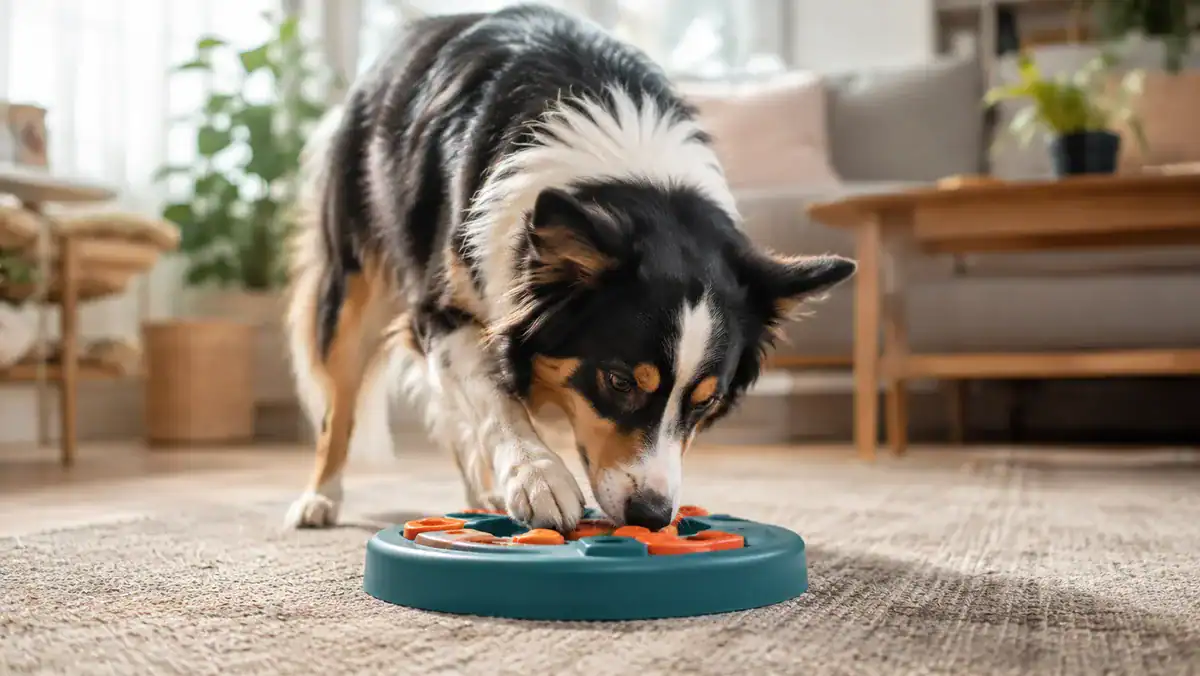
Puzzle toys can give a bored dog something useful to do, but the honest answer is narrower than the marketing: they create opportunities to sniff, lick, forage, chew, and solve a food problem. Small studies and veterinary behavior guidance support those activities as enrichment, yet no toy is proven to “fix boredom” for every dog.
The difference usually comes down to fit. An easy, food-motivated task may turn a rushed meal into several minutes of focused activity. A puzzle that is too difficult, too fragile, or simply uninteresting can produce frustration—or become an expensive object on the floor.
Pause Before You Buy: the short answer
A puzzle toy is worth trying when your goal is specific: extend a meal, add a short foraging activity, or redirect predictable pre-dinner restlessness. It is less likely to help when the real issue is pain, panic when left alone, insufficient exercise or social contact, or a toy that does not match the dog’s abilities and play style.
Disclosure: Give It A Paws is a participant in the Amazon Services LLC Associates Program. This article contains affiliate links; if you purchase through one of them, we may earn a commission at no additional cost to you. The products below are representative examples, not a claim that either is best for every dog.
How we researched this article
We did not test puzzle toys hands-on. We reviewed peer-reviewed feeding-enrichment studies, veterinary behavior guidance, animal-welfare resources, and manufacturer pages for basic product specifications. Published studies are used for measured outcomes; veterinary and welfare sources are used for setup and safety guidance. Manufacturer pages identify product format and size only. Where we translate that evidence into a buying decision or home routine, we label it as an editorial recommendation rather than a research finding. No manufacturer claim is treated as proof that a toy reduces boredom.
What does “reducing boredom” actually mean?
Boredom is not something a home dog can report directly. Owners usually infer it from context and behavior: pacing before dinner, repeatedly demanding attention, searching counters, stealing objects, barking at routine times, or chewing household items when little else is happening.
Those behaviors do not automatically prove boredom. Destructive chewing can also be associated with normal exploration, separation-related distress, fear, pain, or a learned habit that has been rewarded in the past. A puzzle toy is therefore best treated as a small, testable change—not a diagnosis.
For practical purposes, a puzzle is helping if it produces safe, voluntary engagement and improves the specific routine you wanted to change. That may mean the dog spends longer eating, settles more easily afterward, or chooses the toy instead of looking for another activity. “My dog solved it once” is not the same as a lasting welfare benefit.
What the research actually shows
Food toys can change behavior while they are available
A 2008 pilot study summarized by Purdue University’s Canine Welfare Science group compared eight laboratory-housed dogs given food-filled rubber toys with nine control dogs. While the toys were present, the toy group showed more food-seeking behavior, greater activity, and lower barking frequency. The effects were short-term, and the authors called for larger studies and research into long-term habituation.
That is useful evidence for a limited conclusion: a food toy can occupy some kennelled dogs and change what they do during the session. It does not establish that every companion dog will become calmer, that the effect continues after the toy is removed, or that a board puzzle is equivalent to a stuffed rubber toy.
Small feeding studies suggest meals can become longer and more active
A 2023 study in Veterinary World compared feeding toys and stainless-steel bowls under several conditions. The dogs spent more time eating and interacting with the feeding toys, and activity was higher during toy feeding. The study also reported physiological differences, but it involved only four dogs, so it should be read as preliminary evidence rather than a universal result.
The most defensible takeaway is not that a puzzle “burns off” a fixed amount of energy. It is that changing food delivery can make eating take longer and require more behavior than eating the same food from an open bowl.
The broader enrichment case is stronger than the case for any one toy
The RSPCA Knowledgebase describes enrichment as a mix of mental and physical activities that allows dogs to perform natural behaviors. It includes feeding puzzles as one option, alongside walks, social interaction, training, scent activities, play, and environmental variety. It also warns that poorly chosen enrichment may have no effect or cause harm through overfeeding or swallowed toy pieces. VCA separately notes that a task that is too difficult can create frustration.
Veterinary behavior guidance from VCA similarly describes foraging toys as a way to encourage sniffing, seeking, licking, chewing, and manipulation. That guidance emphasizes choosing the right size and difficulty, supervising initial use, and changing the task if the dog becomes frustrated.
Which type of puzzle fits your actual goal?
“Puzzle toy” covers several different tools. Choose the action you want the dog to perform rather than buying the product with the most compartments.
| Goal | Good Starting Format | Why It May Fit | Main Tradeoff |
|---|---|---|---|
| Make a meal take longer | Stuffable rubber toy or simple dispenser | Turns part of the normal ration into licking, rolling, or extraction | Can be messy and requires thorough cleaning |
| Encourage sniffing | Snuffle mat or supervised food search | Low-mechanism task for dogs that enjoy scent work | Fabric may be unsafe for dogs that shred or swallow it |
| Introduce problem-solving | One-step slider, lid, or visible-compartment puzzle | Makes the reward easy to understand before adding more steps | Removable parts and edges invite chewing in some dogs |
| Occupy a power chewer | Correctly sized, durable stuffable toy | Combines food extraction with a more robust material | No toy is indestructible; damage still requires removal |
Two simple formats to compare
These examples represent two different starting points rather than a first- and second-place ranking. The better choice is the format that matches the behavior you want, the food you plan to use, and the way your dog handles toys.
KONG Classic — Large, Red
This is a stuffable natural-rubber toy rather than a board puzzle. It fits routines built around licking, chewing, and gradually extracting soft or mixed food. The linked listing is the Large red version, so check KONG’s size guidance instead of assuming this size fits every dog.
Consider another format if: your dog is likely to damage or swallow rubber, guards filled toys, or needs a lower-chewing task. Supervise the first sessions and remove a damaged toy.
Check KONG Classic Large on AmazonOutward Hound Nina Ottosson Dog Smart — Level 1
This beginner board puzzle uses hidden food compartments and removable covers. It is a more visible cause-and-effect task than a stuffed rubber toy and can suit dogs learning to search and move pieces for food. “Level 1” is a product difficulty label, not a guarantee that every first-time dog will find it easy.
Consider another format if: your dog tries to chew or swallow puzzle pieces, becomes frustrated by covered food, or needs a dishwasher-safe feeding tool. Introduce it while supervised and put it away after the session rather than leaving it as a chew toy.
Check Dog Smart Level 1 on AmazonIf chewing strength is the primary concern, start with our guide to durable toys for aggressive chewers. Durability and puzzle difficulty are separate questions: a clever design is not useful if the dog can immediately remove and swallow a piece.
Start easier than you think
A first puzzle should teach the game, not test the dog. VCA’s veterinary behavior guidance recommends an easy starting level that keeps the animal interested without creating frustration. Difficulty can be increased after the dog understands how its actions release food.
- Use familiar food. Begin with part of the dog’s normal meal or a food already known to agree with them.
- Make the reward visible and easy to reach. Leave compartments open, use a larger dispensing hole, or place food loosely near the opening.
- Show the basic movement once. Roll, lift, or open the toy so the dog can see that food appears. Avoid repeatedly solving the entire task for them.
- End before frustration takes over. If the dog barks at the object, bites at hinges, walks away repeatedly, or looks unable to continue, make the next attempt easier.
- Increase one variable at a time. Add one closed compartment, use a slightly tighter filling, or reduce the number of dispensing holes—not all three at once.
Consider another activity if: your dog ignores food, becomes distressed, guards the toy, or tries to dismantle it instead of using the intended mechanism.
How to tell whether the puzzle is helping
This is an editorial measurement method, not a validated clinical test. It is a simple way to replace guesswork with observations before buying increasingly difficult toys.
- Name one target. Examples include finishing dinner in seconds, stealing dish towels while dinner is prepared, or barking during a predictable quiet period.
- Record a short baseline. For three ordinary days, note meal duration or how often the target behavior occurs during the same time window.
- Use the same measured ration. Put part or all of the normal meal into an easy puzzle for the next several comparable sessions.
- Watch the quality of engagement. Productive engagement looks like sniffing, licking, pawing, nudging, pausing, and returning. Frustration may look like frantic biting, repeated barking at the toy, guarding, or abandoning it.
- Compare the outcome. Keep the toy if the dog uses it safely and the target routine improves. Simplify, change formats, or stop if the problem is unchanged or new problems appear.
Rotation can help preserve interest, but rotation does not require buying a cabinet full of toys. Changing the filling, using a cardboard search under active supervision, hiding kibble in a safe room, or alternating a stuffable toy with a snuffle activity can provide variety.
When a puzzle toy is not the answer
The dog is distressed when left alone
A food toy may help some dogs through a normal departure, but it does not treat separation anxiety by itself. The American Veterinary Society of Animal Behavior describes separation anxiety as a serious welfare issue and recommends professional help when a dog panics while alone. A dog that cannot settle or engage with a familiar activity during an absence may be too distressed for enrichment alone to solve the problem.
For the distinction between a useful management toy and treatment for a behavior disorder, read our guide to toys for separation-related behaviors.
The dog suddenly becomes restless or destructive
A sudden or persistent behavior change warrants veterinary advice because health problems can cause behavior to change. Tell your veterinarian about the timing, frequency, pattern, and any physical signs rather than assuming the dog needs more enrichment.
The daily routine is missing basic needs
A puzzle cannot replace opportunities to toilet, move comfortably, sniff outdoors, train, rest, and interact socially. Enrichment works as part of a varied routine. If the dog receives little exercise or spends long periods isolated, adding one feeder may occupy a few minutes without addressing the larger gap.
Practical safety limits
- Supervise every new format. The ASPCA advises close, active supervision with DIY enrichment and immediate removal if the dog attempts to ingest the material.
- Choose a size that cannot be swallowed. Follow the maker’s current size guidance and account for the dog’s mouth size and chewing behavior.
- Separate dogs when needed. Food-filled toys can become high-value resources. VCA advises using barriers or separate spaces for pets that may steal or guard them.
- Count the food. Use measured meal portions when possible. Rich fillings added on top of normal meals can quietly increase daily calories. Our guide to lower-calorie dog treats explains why repeated small rewards still need to be counted.
- Inspect and clean after use. Remove toys with cracks, sharp edges, loose fibers, missing pieces, or enlarged openings. Wash away trapped food and let the toy dry fully.
- Adapt for physical limitations. Dogs with dental pain, neck discomfort, arthritis, impaired vision, or mobility limitations may need a softer, stationary, raised, or easier activity selected with veterinary input.
Frequently asked questions
Do puzzle toys really tire dogs out?
They can occupy a dog and require sniffing, licking, movement, and problem-solving. Research supports increased activity and longer food engagement in some settings, but there is no universal conversion between puzzle time and physical exercise.
Can I feed every meal through a puzzle?
Some dogs can eat most or all of a measured ration through appropriate foraging toys. Monitor total intake, frustration, hygiene, guarding, and whether the dog can use the device comfortably. A dog should still have reliable access to enough nutritionally complete food.
Why does my dog chew the puzzle instead of solving it?
The task may be too difficult, the construction may invite chewing, or chewing may simply be more rewarding to that dog. Make the food easier to access and switch to a simpler, more durable format. Remove the toy if pieces can be detached.
Are snuffle mats safer than plastic puzzles?
Not automatically. A snuffle mat can be a gentle, stationary option for a dog that searches with its nose. It can be unsafe for a dog that tears and swallows fabric. Safety depends on the individual dog’s behavior, the material, the size, and supervision.
Should I leave a puzzle toy out all day?
Usually there is little reason to. Putting food toys away after use makes inspection and cleaning easier and may help preserve novelty. Previous supervised use does not guarantee future safety. Follow the current manufacturer instructions, never leave a product labeled for supervised use only, and remove any toy if your dog bites off or loosens material.
Can a puzzle toy stop destructive behavior?
It may redirect a predictable, boredom-related behavior during the period when the toy is available. It will not reliably resolve destruction caused by panic, pain, fear, inadequate management, or access to tempting household objects.
The bottom line
Puzzle toys are not a gimmick, but they are not a cure-all. Their practical value is straightforward: they can turn food into a longer sequence of natural behaviors and give a dog a defined activity during an otherwise empty part of the day.
The best first purchase is rarely the hardest puzzle. Start with a simple, correctly sized format, use part of the dog’s normal ration, supervise the learning process, and measure whether the routine you care about actually improves. If the dog is safe, engaged, and easier to settle afterward, the toy is doing useful work. If the dog is frustrated, destructive, guarded, or uninterested, pause before buying another level and change the plan.
Sources reviewed
Peer-reviewed research is used for measured behavioral and feeding outcomes. Veterinary behavior and animal-welfare sources are used for practical setup, safety, and behavioral limits. The small samples and controlled settings in the research mean the findings should not be treated as guaranteed results for every household dog. Manufacturer sources are included only for the specifications of the two product examples. Sources reviewed September 26, 2026.
- Purdue University Canine Welfare Science — Summary of Schipper et al. (2008), feeding enrichment toys in kennelled dogs
- Veterinary World — Feeding toys, owner presence, behavior, and physiological measures in a four-dog study
- RSPCA Knowledgebase — Why enrichment is important for dogs, including benefits and limitations
- VCA Animal Hospitals — Veterinary behavior guidance on enrichment and foraging toys
- ASPCA — Canine DIY enrichment and supervision guidance
- American Veterinary Society of Animal Behavior — Separation-anxiety signs, video observation, and when to seek help
- KONG Company — KONG Classic material, format, and available sizes
- Outward Hound — Nina Ottosson Dog Smart Level 1 product format and safety information
- Merck Veterinary Manual — Why health problems should be ruled out when a dog’s behavior changes