
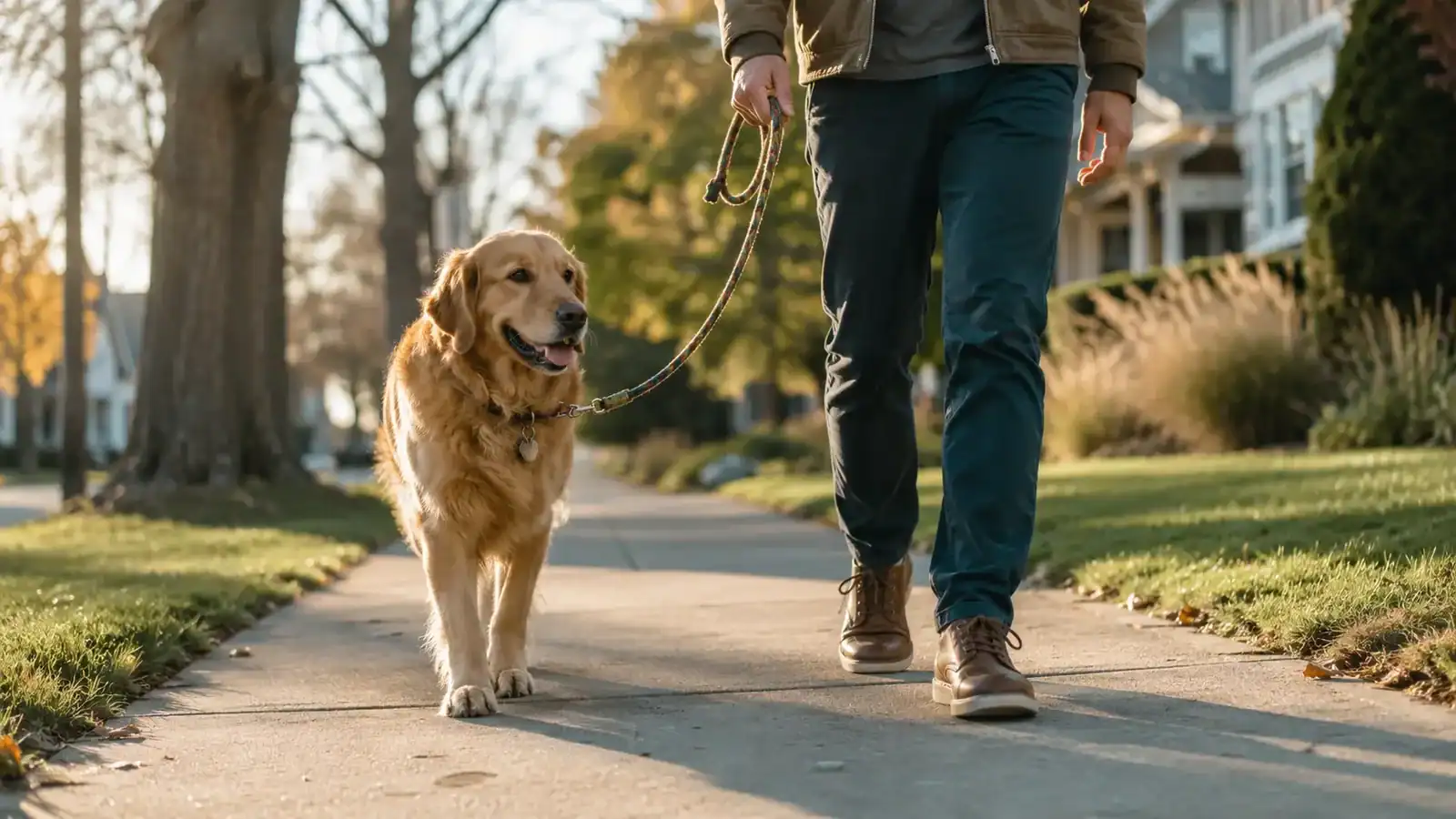
“No-pull harness” is one of the more confusing labels in the pet aisle. It sounds as though a dog will stop pulling as soon as the harness goes on, but that is not what the equipment actually does.
A no-pull harness is better understood as a management tool. Depending on its design, it may make a pulling dog easier to redirect or give the handler more control. It does not automatically teach the dog how to walk calmly on a loose leash.
Pause Before You Buy: the short answer
Choose the attachment style for the control your dog needs now, but do not expect a “no-pull” label to replace fit checks or loose-leash training. A front or dual clip can help redirect a dog that pulls; a back clip may be enough for a dog that already walks calmly.
Disclosure: This article may contain affiliate links. If you purchase through one of our links, we may earn a commission at no additional cost to you. Our recommendations are not ranked based on commission.
How we researched this article
We did not test harnesses hands-on for this article. This guide is based on published research about dog-walking equipment, educational fitting guidance, reward-based training recommendations, and official product specifications. We separate what a harness can mechanically help with from what still requires training.
The basic difference: where the leash attaches
The terms “regular harness” and “no-pull harness” are not strict technical categories. Manufacturers use different construction methods, but the main difference usually comes down to the leash attachment position.
Back-clip harness
A back-clip harness connects the leash above the dog’s back, usually near the shoulder blades. It is a simple setup that may work well for dogs that already walk calmly or do not need additional directional control.
Because the leash pulls from behind the dog, a standard back attachment generally does not redirect forward movement. A dog that leans into the harness can continue putting body weight against the leash.
Front-clip harness
A front-clip harness connects the leash near the center of the chest. When the dog moves strongly toward the end of the leash, the off-center connection can help turn the dog’s body back toward the handler rather than allowing the dog to continue moving directly forward.
The result depends heavily on fit. If the harness is loose or poorly matched to the dog’s proportions, the front attachment may pull the harness sideways instead of providing controlled redirection.
Dual-clip harness
A dual-clip model provides both front and back leash attachments. This gives the owner the option to use the back connection for relaxed walks, the front connection when more redirection is needed, or a double-ended leash attached to both points.
Examples such as the Ruffwear Front Range and 2 Hounds Design Freedom are included in our guide to harnesses for strong pullers .
What a no-pull harness can—and cannot—do
A front attachment can give the handler more leverage by redirecting the dog’s forward movement. That may make walks more manageable, particularly while the dog is learning loose-leash walking.
What it cannot do is remove the dog’s motivation to pull. A dog may still pull because of excitement, fear, frustration, habit, or interest in something ahead. The harness changes how that force is managed; it does not resolve the underlying behavior by itself.
A realistic expectation
Use a no-pull harness to make training sessions easier to manage—not as a replacement for rewarding the dog when the leash is loose and attention returns to the handler.
What the research actually tells us
One experiment discussed in a published review compared a neck collar with a back-clipped chest-strap harness in 52 shelter dogs attracted with food. Mean and maximum leash tension, along with the proportion of time spent pulling, were higher in the harness condition.
That finding requires context. The study compared a harness with a neck collar; it did not establish that every front-clip, back-clip, and dual-clip design has the same effect. It also did not prove that harnesses teach dogs to pull.
The more cautious conclusion is that changing equipment alone may not reduce a dog’s desire to pull. Harness design, fit, leash handling, prior training, and the individual dog all influence the result.
Research into harnesses also suggests that different designs may affect movement differently. Evidence is still limited, so claims that one harness style is universally comfortable or completely non-restrictive should be treated carefully.
When a no-pull harness may be the better choice
A front-clip or dual-clip harness may be worth considering when:
- Your dog regularly pulls or lunges during walks.
- You need additional directional control while working on loose-leash training.
- A back-clip harness allows your dog to lean forward with its full body weight.
- You want the flexibility to switch between front and back leash attachments.
A no-pull harness should not be used to jerk or sharply spin the dog. The front attachment is intended to assist with redirection, not to create punishment through sudden leash force.
Consider another option if: The front attachment consistently shifts, rubs, or does not suit the dog’s response to chest pressure.
Main tradeoff: More control does not remove the dog’s motivation to pull or replace training.
When a regular back-clip harness may be enough
A back-clip harness may be the simpler choice when:
- Your dog already walks calmly without regularly reaching the end of the leash.
- Your main priority is a straightforward attachment for casual walks.
- The dog does not respond well to leash pressure applied from the chest.
- You are using purpose-built equipment for an activity in which controlled pulling is intended.
Canicross is an intentional pulling sport that uses a comfortably fitted sport harness, a bungee line, and a runner’s belt. A normal everyday back-clip harness should not automatically be treated as canicross equipment.
Consider another option if: The dog regularly leans forward, lunges, or needs additional directional control.
Main tradeoff: A rear attachment offers limited help with redirecting forward pulling.
Quick comparison
| Situation | Starting Option | Why | Main Limitation |
|---|---|---|---|
| Dog regularly pulls forward | Front or dual clip | Provides directional redirection | Does not replace training |
| Dog already walks calmly | Back clip | Simple everyday connection | Limited pulling control |
| Training in different environments | Dual clip | Allows the connection point to change | More straps and fitting complexity |
| Canicross or intentional pulling | Purpose-built sport harness | Designed to distribute pulling force | Not intended for ordinary leash control |
Fit matters more than the product label
A harness labeled “no-pull” can still be uncomfortable or ineffective if it does not fit correctly. Check the manufacturer’s current sizing chart and measure the dog instead of selecting a size based only on breed or weight.
A commonly used starting point is enough room to place two fingers between the harness and the dog’s body. The harness should remain centered while the dog walks, without rotating around the chest or sliding toward the throat.
Check that the straps do not sit directly in the armpit area and that the dog can move normally. After the first few short walks, remove the harness and look for redness, compressed fur, damp spots, or areas where the material has been rubbing.
Owners of petite dogs can also see our guide to harnesses for small dogs prone to rubbing and chafing .
The harness should support training, not replace it
Reward-based leash training teaches the dog what to do instead of relying only on equipment to prevent unwanted movement.
Reward the dog when the leash is loose, when attention returns to you, and when the dog chooses to remain close despite distractions. Begin in a quiet environment before expecting the same behavior around dogs, people, traffic, or wildlife.
If pulling is connected to fear, reactivity, or aggression, equipment alone may not address the underlying problem. Consider working with a qualified reward-based trainer or veterinary behavior professional.
Frequently asked questions
Does a no-pull harness completely stop pulling?
No. It may make pulling easier to redirect or manage, but the dog still needs to learn how to walk with a loose leash.
Is a front-clip harness automatically uncomfortable?
No, but comfort depends on the individual design, correct sizing, adjustment, and how the leash is handled. Stop using the harness if it consistently shifts, rubs, or appears to change the dog’s normal movement.
Can one harness be used as both a regular and no-pull harness?
Yes. A dual-clip harness provides both front and back leash attachments. Make sure the harness fits correctly in both configurations rather than assuming that moving the leash is the only adjustment required.
Can I switch back to the rear attachment later?
Yes. Some owners use the front attachment while loose-leash skills are developing and switch to the back attachment when the dog walks more calmly. The right setup depends on the dog and the walking environment.
Should I use a no-pull harness for a puppy?
It can be used if the harness fits correctly and is introduced gradually. Puppies grow quickly, so check the fit frequently and avoid relying on the harness instead of teaching leash skills.
The bottom line
If your dog regularly pulls, a well-fitted front-clip or dual-clip harness may provide useful redirection while you work on loose-leash skills. If your dog already walks calmly, a regular back-clip harness may be the simpler choice. In either case, prioritize fit, check for rubbing or restricted movement, and treat the harness as support for training rather than a complete solution.
Sources reviewed
Published research and educational sources are used for general conclusions about harnesses, movement, pulling behavior, fitting, and reward-based training. Manufacturer pages are used only to confirm specific product features. Sources were reviewed September 24, 2026.
- Review of collars, harnesses, and head collars for walking dogs — supports the discussion of pulling-force observations and the limits of current equipment research.
- American Kennel Club — How to put on and fit a dog harness — supports general fitting and adjustment guidance.
- American Veterinary Society of Animal Behavior — Humane dog training position statement — supports the reward-based training approach discussed in this guide.
- CaniCross trailrunners — beginner equipment guidance — supports the distinction between purpose-specific canicross equipment and an everyday walking harness.
- Ruffwear Front Range official product information — confirms the product’s leash-attachment features.
- 2 Hounds Design Freedom official product information — confirms the product’s leash-attachment features.